

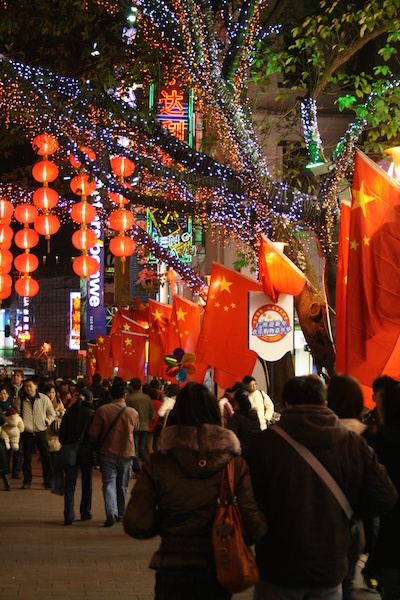
 Today is the first day of the Year of the Monkey, according to the lunar calendar observed by over one billion Chinese people around the world. To mark the Chinese New Year, Disciples Today is publishing a series of articles written by our correspondent in mainland China, who is even now celebrating the Chinese New Year in southern China. (See Part 1: Good News from China.)
Part II: What's it like to be a Christian in China?
All over the world, Chinese culture is known through some of its most visible incarnations outside of China: kung-fu, Chinese characters written as calligraphy, and perhaps most commonly, through Chinese food!
Of course, Chinese culture has many more dimensions than these, and in a country as large and populous as China, there’s an incredible variety of people and customs.
The life of Christians in China is often not well understood. Usually, much attention focuses on the persecution of Chinese Christians. These stories can be exciting and inspiring (especially if they end with the subjects of persecution demonstrating great faithfulness), but they don’t really convey what it means to be a disciple of Jesus in China.
Certainly there are cases of persecution, but for most Chinese Christians, government persecution is not a major concern. China, both officially and unofficially, allows more freedom of religion than many countries in the world. Throughout China, church buildings of government-sanctioned Catholic and Protestant groups hold open church services. The world’s largest Bible printing press is even in China! Amity Press, in the central Chinese city of Nanjing, has produced over 100 million copies of the Bible. Chinese Christians often wears crosses, carry their Bibles openly and share with friends and co-workers their belief in Jesus.
In other ways, Christianity is more restricted in China; for example, open evangelism is prohibited. Only the two state-sanctioned Protestant and Catholic churches have legal status. Christian groups outside these officially-sanctioned churches are popularly known as “underground’ churches. But In most places, as long as they do not cause problems or meet in large groups, local governments don’t interfere.
When people ask, “Is it hard to be a Christian in China?” I share these common struggles:
Materialism: China’s red-hot economy has a big downside—consumerism. It’s a constant challenge for disciples to resist the new car, new home, latest-gadget worship that has captivated many Chinese young people.
Family pressure: Because of the (now greatly relaxed) one-child policy that the government used to slow population growth, many Chinese disciples are only children. Their families expect and often need financial support. Housing costs in the big cities are among the highest in the world, and most urban Chinese think of home ownership as a prerequisite for marriage. Some worry they can never be able to afford a home or get marry before they are middle-aged! Disciples face simultaneous pressure to marry by age 30, but few can meet the culture’s financial expectations just to get married.
Impurity: Pornography is ubiquitous, and a hook-up culture permeates single life the major cities. Divorce is on the rise and traditional mores have been replaced with a casual attitude towards sex outside of marriage. Combined with the financial pressure that makes it hard to marry before age 30, this is a potent and dangerous mix.
 And the bright side of being a Christian in China?
A sense of mission: Most disciples are the first Christian in their families. Christianity is still something of an unknown for many Chinese, who have a superficial but often positive impression. Chinese disciples are much more likely to be a part of a church planting. There are hundreds of large cities in need of churches—a wide-open frontier for the gospel.
Close relationships: Chinese have a reputation for putting a premium on the value of relationship, and the church is a natural environment for deep, mutual relationships. The smaller groups that disciples here tend to meet in foster closeness. Chinese travelling together in groups, rather than solo, is something of a stereotype—but there’s an underlying truth to it. Chinese Christians have a strong experience of church as family and friends.
A unique identity: People are everywhere in China, often in big, pressing crowds. It’s easy to get lost in this sea of people, but for Chinese disciples, life has a bigger meaning than just “getting ahead” or “holding my own in society.”
Being a Christian in China is different from being a Christian anywhere in the world—but also the same. Jesus puts us all together in one family. Would you take a moment, on this special day on the Chinese calendar, to pray for your Chinese brothers and sisters?
Next in this series: A Short History of Christianity in China