

To mark the Chinese New Year, Disciples Today is publishing a series of articles written by our correspondent in China. For the previous articles in this series, see Part 1: Good News from China and Part 2: What’s It Like to Be a Christian in China?
Part III: A brief history of Christianity in China
 In the early 1620’s, workers unearthed a nine-foot tall stone monument near Xian, China. The inscription shocked local Jesuit missionaries: the text contained references to Genesis, baptism, the Trinity and the Incarnation. At its top, sitting above over 1,700 Chinese characters documenting the first know contact between Christianity and China, was a clear representation of a cross. The monument was erected in A.D. 781 and commemorates the Syrian missionary Alopen, who arrived in the Chinese capital Chang-An in A.D. 635. At the time, Chang-An was possibly the largest city in the world, and Alopen was welcomed by Emperor Taizhong.
Alopen’s converts multiplied, but about 200 years later, they were virtually wiped-out in an all-encompassing persecution directed at Buddhism but effecting other religions as well.
The Christian faith Alopen carried to China survived, ironically, among the Mongols to the north. Several of Genghis Khan’s sons married women who considered themselves Christians, and some Mongol tribes were primarily Christian as well. Christianity came again to China hundreds of years later when the Mongol-led Yuan dynasty established itself throughout China.
Matteo Ricci, one of history’s most impressive Catholic missionaries, arrived at Macau in 1582. Ricci was a brilliant scholar in mathematics and astronomy. He made extraordinary efforts to adapt himself to Chinese culture, adopting the clothing style of a Confucian scholar and learning not only to speak Chinese, but also to read and even write in classical Chinese. He was the first Westerner to be invited to live in the Forbidden City, where the Emperor lived in Beijing. There, he converted a number of officials and prominent citizens. Ricci died, and was buried, in Beijing.
Of the hundreds of Protestant missionaries who arrived in China in the 1800’s, few compare with Hudson Taylor. He founded a mission society that mobilized over 800 missionaries, who themselves started some 125 schools. He learned Mandarin Chinese as well as several Chinese dialects. He sacrificed as much as any missionary ever has, burying a wife and several children who died in China, and he himself died and was buried in China. Though widely criticized at the time by other missionaries for dressing in Chinese style and for his unapologetic use of single women in the mission, Taylor is now recognized as one of the greatest Protestant missionaries of all time.
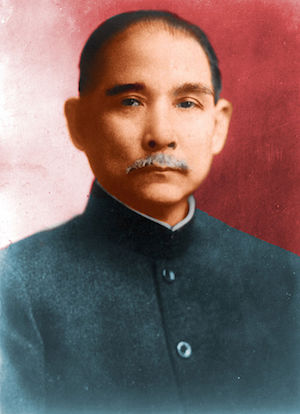 Christians started the first modern hospitals and clinics in China, and Christianity spread rapidly among both intellectuals and rural people. The revolutionary leader Sun Yat Sen—recognized to this day as the founding father of modern China for bringing about then end of the Qing Dynasty—was baptized in Hong Kong and attended a church as a medical student.
Christianity again fell under persecution after 1949. All foreign missionaries were expelled from China, and church properties, schools and hospitals were nationalized. The Cultural Revolution brought more suffering, but the spread of Christianity continued—though largely driven underground—some believe, at an even faster pace that it had grown in the years before. Thousands of Chinese went from village to village, preaching and organizing house churches.
Today, if one includes all the Christian traditions—Catholic and Protestant, underground and government-sanctioned—researchers believe there may be as many as 80 million (some say more) Chinese who call themselves Christians.
This is an impressively big number—but every plausible estimate of Christianity in China still shows fewer than 10% of the population have any type of Christian belief. In most provinces, Christians are fewer than one percent of the population. The work left to do is daunting. However, the history of Christianity in China gives us hope that there are untold millions of Chinese who will come to Christ if only given the opportunity.
Next in this series: The International Churches of Christ in China