


 Time to stand up and reduce your risk
Today, October 13, 2011, is the day of International Disaster Risk Reduction; a sobering day to remember that we are at greater risk of experiencing both natural and man-made disasters.
The World Disaster Report 2011 describes:
- how the last decade (2001 to 2011) has been impacted by 7,070 disasters across the continents
- 2.7 billion people were affected
- 1.3 million died.
- Earthquakes caused the most human fatalities (52%)
- Windstorms caused the second most human fatalities (13%).
- Total financial cost: $1 trillion, mostly by windstorms (52%).
On September 12, 2011, Dr Kristalina Georgieva, European Commissioner for Humanitarian Aid and Crisis Response explained that disaster rose five times in the last decade while the cost of living has also rose 10 times, making the humanitarian response even more difficult.
Ninety percent of all disasters happened in the Asia Pacific region where development and poverty challenges co-exist, while other developed countries are experiencing ‘unthinkable’ disasters. Our challenge is to think the unthinkable and reduce our risk of disasters.
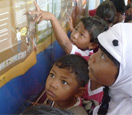
pictures: Children learn to reduce their risk through materials developed by HOPE worldwide (left), School teachers and community leaders conduct risk analysis of their neighborhoods (right)
Healing and Empowering
HOPE worldwide as a relief and development NGO has been diligently working in communities around the globe assisting them by helping relieve their suffering, and reduce their risk in the face of danger. Communities in Haiti are recovering through housing and health initiatives. Families in Indonesia’s West Papua are planting seeds for the future. Those who are handicapped and seniors are learning ways they can be resilient in Japan’s Tohoku region. In the Ivory Coast, children and campus students are being empowered in the city of Abidjan. These are just a few of the relief and recovery programs of HOPE worldwide’s Global Disaster Response division.
New Challenges and a Solution
As I write this, HOPE worldwide’s staff and volunteers are on the ground in Manila, Philippines and Bangkok, Thailand. They assist with flooding caused by tropical storms, while an earthquake registering 6.8 in Bali, Indonesia keeps that country’s disaster response team on alert.
The answer is simple: We need to invest in disaster preparedness and disaster risk reduction work. Prevention saves lives.
In Indonesia, HOPE worldwide has trained more than 300,000 children how to reduce their risk in a disaster. Our development programs are striving to tackle health and education issues of the poor and under-developed communities worldwide. Without critical education they are bubbles that explode when disaster hits; like Haiti witnessed in 2010. Community volunteerism is key to involving everyone at risk.
Picture: Students learn life-saving “duck and cover” techniques in response to an earthquake.
Today and every day, please remember our global community who have been affected by disaster. Let us strive to reduce the risks, starting with ourselves and our communities. Stand up to reduce your risk.