Steps of the Apostles — A Trip of a Lifetime!
 Disciples Today organized this cruise on the Celebrity Silhouette (pictured below) for 106 disciples from the International Churches of Christ
Disciples Today organized this cruise on the Celebrity Silhouette (pictured below) for 106 disciples from the International Churches of Christ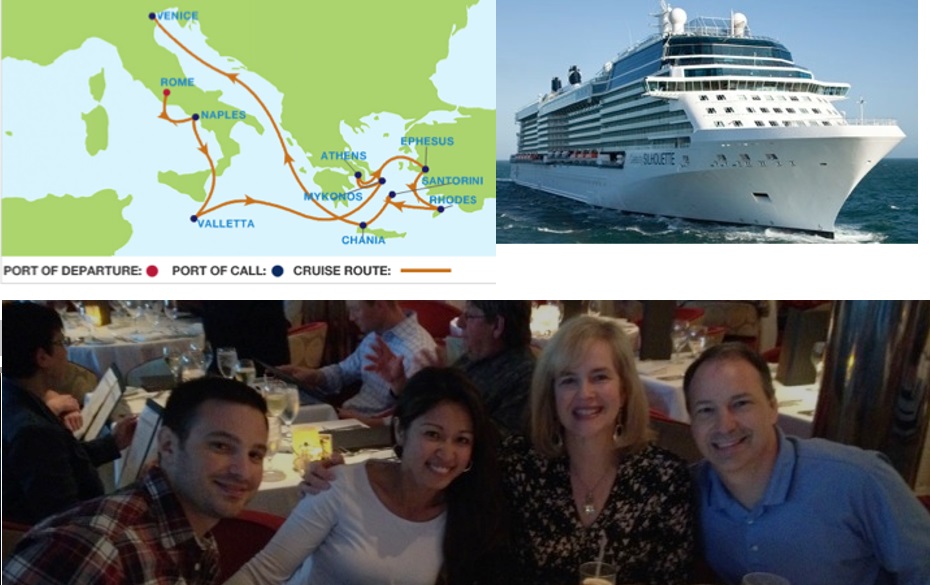
October 18: Rome — The Capital City
We arrived at 8:30 AM to the airport in Rome, met our cruise partners Nick and Nerene Merlino (above), and took Bob’s Limousine to Hotel Piazza de Spagne (right), a boutique hotel at the Spanish Steps in the center of Rome’s tourist area. After dropping our bags at the hotel, we walked the streets of Rome to many of the prime attractions.
We started at the Spanish Steps, the largest staircase in Europe, built in 1725 and made famous in Gregory Peck and Audrey Hepburn’s “Roman Holiday.” Next stop was the famous Trevi Fountain, first completed in 1762, refurbished in 1998, and made famous through movies that romanticize throwing coins in the fountain. Beth threw in one Euro coin, contributing to the 3000 Euros that tourists wish on each day!
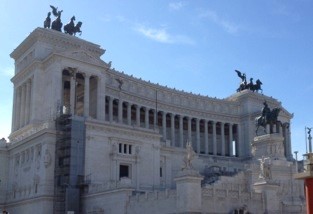 Rome consists of (randomly?) interconnected squares or “Piazzas.” We strolled through Piazza Navona with an amazing church, entertaining artists, and of course a beautiful unique fountain; Piazza del Popolo, a little north of our hotel with twin churches, next to the Villa Borghese, overlooking the city; and the Piazza Venezia with beautiful white marble Museum (left) on the way to the Coliseum and Forum. On the way we saw the ruins of the ancient Capital, and I wondered what our Capitol (DC) will look like in 2000 years! The Forum was closed and we didn’t really have time (or energy) for the full Coliseum tour, so we took some pictures and enjoyed the costumes, peddlers, and sites (floating man, invisible man, Centurions, Egyptian, etc.).
Rome’s biblical significance stems from Paul’s letter to the church in Rome and the sites where Paul and Peter were martyred. Additionally, Roman Emperors including Nero and Domitian heavily persecuted the early Christians (as depicted in the Book of Revelation), murdering them by burning them as torches, feeding them to the lions, or torturing them in other ways, often in the Coliseum. After Constantine legalized Christianity (313, Edict of Milan), Rome became a central city and power in the Catholic Church.
October 19: Boarding the Celebrity Silhouette
The cruise ship, shown above, was amazing. This 14-story floating city is only a few years old, holding 3000 passengers with more than a dozen restaurants, shopping, casino, theater, spa, pools, health club, and 100s of doting attendants. Our 7th floor balcony sunset veranda room (right) on the rear of the ship served as our floating hotel in the Mediterranean.
 October 20: Pompeii (From Naples) — City Frozen in the First Century
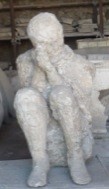
As newbies to Naples, we didn’t realize that it was so close to Pompeii. We gathered an adventurous group of 18 and took the 20-minute walk followed by a 30-minute train ride that delivered us to the city that was buried alive in the eruption of Mt. Vesuvius in 79 AD. Recent excavations reveal the first-century city in livid detail not available in most ruins today. Our guide Matilda directed us for 2 hours through streets of villas and fountains; temples to Apollo, Jupiter, Venus; spas with cold, warm, and hot rooms; markets for meat, fish, and bakery; the theatre and gladiator training grounds; and even the brothels (25 in the city) with their unusual advertisements and signs. The most haunting sites were the life-like bodies, reconstructed through an amazing plaster technique that maintained the exact shape of bodies, kept the skeletons (even animals) in tact, and portrayed the positions they took as they were buried alive by the volcano (right). Although Pompeii does not have any biblical significance, it is educational to see a city frozen in time since the first century, preserved for us to see. To download this blog, with more pictures, click here.
October 21: Malta — Paul’s Shipwreck and Imprisonment on the way to Rome
The stunning fortified Valletta greets the approaching ships through an amazingly majestic port (right) with tan stone (native), high walls, and imposing city buildings. Malta’s independence was originally delivered by the Knights of St John in the 1500s, who protected Europe from the Turks by fortifying the city including dozens of observation towers in line of sight to one another.
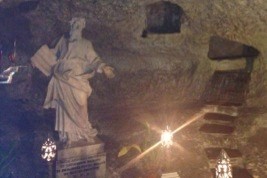 Malta’s Biblical significance stems from the shipwreck of Paul after a 2-week storm on his way to Rome. The island is 95% Catholic and memorializes Paul’s trip including the Grotto that housed Paul's prison. The original capital city, Mdina, is an imposing walled city that now only houses 300 citizens, as the capital moved to Valletta to be closer to the coast.
 One of the Steps participants, Angie Hoover, grew up in Malta and shared about the Island's history including recent independence. We met her parents in town but not her Aunt, who is currently the President of the country! Angie and her husband Lowell shared about the shipwreck of Acts 27 and the bay where Paul landed. There is debate among scholars whether Paul landed at today’s “St. Paul's bay” or if perhaps the southern “St. Thomas Bay” may be the more accurate site.
October 23: Mykonos — Windmills and Whitewash
Our first taste of the Greek Islands included the patriotic (blue and white colors represent the Greek flag) whitewashed buildings with blue tops, windmills, dozens of cats, quaint streets, gaudy Orthodox churches, breathtaking views of the Mediterranean and no shortage of food and shopping. No Biblical significance, but Paul sailed by many islands like this.
October 24: Ephesus — Paul, John, and the Church in Asia Minor (Turkey)
Excavations of Ephesus began in the late 19th century. Austrians lead the work and continue to make progress. We toured starting with the Roman 3-tiered bath (hot/warm/cold), the city gate, and the legal/parliament municipal house that resembles a small theater. Temples to Venus, Apollo, and Jupiter greet the visitors to the city. The 24,000-seat theater (below) features amazing acoustics so our group of 106 sang together “Sing Hallelujah to the Lord” to the rousing applause of the other tourists.
Later, in Acts 20, Paul sailed through the region but avoided another confrontation in Ephesus by meeting the Ephesian elders in Miletus. We visited Miletus, 45 minutes south by bus. When Paul sent for the Ephesian elders they must have had a longer trip (no buses)! We couldn't see the beach they prayed on (they pointed us in the direction) since the sea silted up and is no longer close to the city, but we saw the remains of the large city with a theater and various other buildings.
We finished the day with a hearty lunch at a location across from the massive temple of Apollo and returned to the port at Kusadasi for some interesting shopping at the local Bazaar. We found the local merchants to be quite kind, funny, and even reasonable, noting that they expect you to bargain with them.
On this tour, we skipped a key site that we visited in 2007: the church of St. John. This burial place of the apostle John helps visitors to capture the significance of John and Jesus’ mother Mary moving to Asia later in life. John, author of the Book of John, Revelation, and the three letters 1/2/3 John, spent decades helping to strengthen churches in modern day Turkey including the seven churches mentioned in Revelation 2-3. Later John was banished to Patmos, a Greek island just off the coast of Turkey, where he wrote the Book of Revelation. The Church of St. John is located close to the former site one of the Seven Wonders of the Ancient World, the Temple of Artemis. As with many of the ancient ruins, you can now see the remains of this site at the British Museum.
October 25: Rhodes – Giant Colossus Replaced by Two Deer
Mentioned briefly in Ezekiel 27 and Acts 21, Rhodes is a very well protected Island also liberated and fortified by the Knights of St. John. Though Ottoman Turks ruled the island until 1912, Greece took control of the Island from Germany after World War 2.
We docked in the port close enough to walk past the dolphin statue and enter through one of the many city gates. Massive fortifications protect the city. The 30 meter high Colossus of Rhodes once stood across two planks in the port, another of the Seven Wonders of the Ancient World. For some reason they replaced the statue with two small deer (below). We enjoyed some Greek food, purchased our magnet, and snapped photos of the sites.
 October 26: Santorini – Picturesque (except for the donkey dung)
The most picturesque of our stops was not actually a biblical site, although some claim that Santorini with its active volcano was actually the site of the lost city of Atlantis. We were on our own with the Merlinos, so we negotiated a boat to the beautiful city of Oia (e-ah) to take pictures, followed by bus ride back to the port city, Fira. This allowed us to see nearly the whole island in a few short hours. Our favorite stop on the cruise included some of the trip’s best places for pictures and our favorite Greek meal at Delphi Tavern in Fira. We bravely walked past the cable car and descended the steep hill back to the ship on foot. It was quite a workout, made challenging by the slippery steep steps covered in donkey dung and the donkeys passing up and down with no regard for us (left)! I was proud of Beth for making it down, but we all felt strained in our calves for quite some time.
October 27: Athens–Church on Mars Hill
In Acts 17, Paul stayed back in Athens on his own but effectively preached in the Synagogue, Agora (market), and to the Areopagus (Mars Hill), baptizing quite a few people, including leading men of the city. Today, Paul’s sermon is carved in Greek into the side of the hill, just across from the Acropolis and the Parthenon.
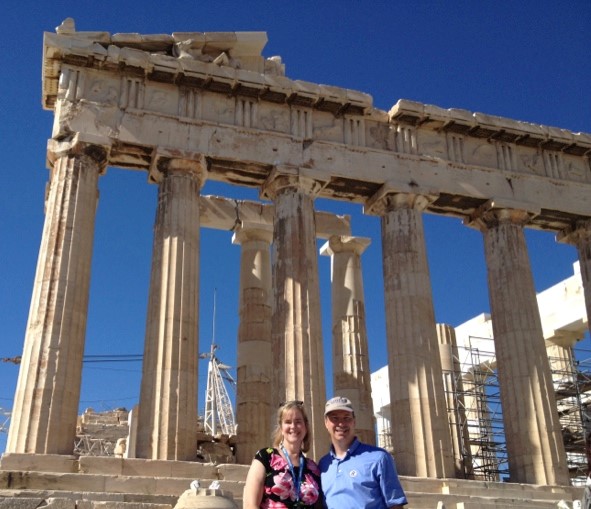 Docking at the Port of Piraeus, we travelled by bus to see Athens’ sites including the original 1896 Olympic stadium and many buildings completed for the 2004 Olympics, though we noticed some run down and questionable parts of the city. We saw the remains of the Parthenon (right) on the Acropolis and hosted a church service on the Areopagus (right). Teo and Maria, local disciples and opera singers, led the group in some powerful singing and Roger Lamb shared from the apostle Paul's perspective about preaching in Athens. At the Areopagus I ran into my college friend, Lucas Lalliotis, who studied at Northeastern University with my high school friend Keri and my brother. We enjoyed a Greek meal (over priced) and walked through the Agora, returning to the ship via buses.
October 28: Crete – Island of History
Because of its strategic position in the Mediterranean, Crete’s history is full of political turmoil. 9000 years ago, the Minoans established a civilization, followed in 1500 BC by Mycenaean Greeks. Rome conquered Crete in 69 BC, leading to a time of relative peace under Roman and Venetian rule. After falling to the Ottoman Turks in the 1600s, many Cretans converted to Islam. Conflict between the Turks and Greece for nearly a hundred years eventually resulted in reunion with Greece in 1913.
Crete is mentioned several times in the Bible. In Acts 2:11, Cretans were present and may have been baptized and returned to their country to start the local church. In Acts 27, Paul landed on the east side of the island and warned the crew not to continue on their way to Rome. Instead, the crew tried to reach Phoenix on Crete’s west coast to winter there. A powerful “northeaster” storm blew them out to sea for the next 14 days, tossing the ship about without seeing stars or sun until they shipwrecked in Malta. Paul later wrote to Titus who led the church in Crete. He warned Titus about the "lazy, gluttons" in Crete but also gave guidance for selecting men as elders and instructions for various groups in the church.
Our ship landed in the northwest port of Chania. We took a local bus into the city, which was mostly closed for a National holiday recognizing the time Crete said "no" to Germany, helping the Allies to victory in WW 2. We saw national (Greek) armies marching and observed the Orthodox Church celebration including singing and ceremony. The Hoover's plans to venture into the island via mopeds and four-wheelers fell through, so we shopped and enjoyed coffee and Wi-Fi with Graham and Susanne Gumley. We talked about Obamacare, elders, Biblical Study Tours, and kids. During our time walking around the island, Beth discovered that Terry Prather's son had similar asthma attack problems to Elena caused by a PH imbalance from acidic foods.
After the short time in Crete (8:30 to noon), we returned to the ship for lunch, nap, and relaxation. The ship’s formal dinner featured lobster tail, beef Wellington, crusted haddock, and lamb chops. The baked Alaska was good, but we liked the desserts at the Bistro on Five better. Overall, the quality of the ship's entertainment was mixed. The first few nights we thought the shows were too cheesy, but the comedian, acrobats, orchestra, and singer from Les Miserable were all excellent. The next two days at sea we relaxed, providing much needed down time. Too many sights tend to overwhelm your brain with history, ruins, photographs, food, and shopping!
October 30: Final Stop at the 118 Islands of Venice
As we entered the port of Venice, we marveled at the 118 islands in the Adriatic Sea with hundreds of palaces that make up this unique city that has no direct biblical relevance. We decided to walk rather than take a water taxi or the expensive gondolas (below), allowing us to see many of the common tourist streets and bridges on the way to St. Mark's Square and to experience less frequently traveled streets on our return. St. Mark's square includes the basilica, Doge Palace, and Tower, though only the basilica was free. We tried pizza slices and sandwiches—nothing too exciting—but purchasing the food allowed us to use free Wi-Fi and toilets. We even found a music museum with a 200-year-old guitar.
There are no cars in the main streets of Venice—only waterways and wandering pedestrian streets. We asked directions nearly every half-mile to navigate the city and try not to end up in a dead end at the water’s edge. We finished our tour by purchasing a cheap (probably not Murano) glass angel, a super-sized cannoli, and an espresso before returning to Piazzala Roma and the "people mover" back to the ship. Nick and Nerene bought a slice of french-fry pizza and a super-sized merengue. We ate dinner back at the ship with wine and dessert before packing and early to bed.
Final Thoughts on our Steps of the Apostles
It would be hard to compare our luxurious all-you-can-eat accommodation experience with any experience of the first century followers of Christ. However, it is amazing to walk on the same streets they walked, see a prison that held Paul, visit the islands that they visited, pray by the beaches they prayed, worship on the same hill where Paul preached, and reflect on their courage as “unschooled and ordinary men” even as they died martyrs deaths in places such as the Coliseum. We landed on the same islands they did as strangers, claiming to share in the lineage of these disciples’ faith, yet not seeing how they could initiate conversations that would lead them to change individual’s lives, plant churches, and turn civilization “upside down.”
Now these same islands memorialize the apostles’ courage with statues, basilicas, guided tours, and a commercialized tourist industry. Yet today, few residents consider the message these apostles preached that at one time helped people understand the dramatic steps that God took to rescue people and welcome them into his family. The apostles called people to take responsibility for their lives, change the way they live, and not only share this message with others, but live a life that proclaims Jesus as God’s chosen savior and messiah. The bells of the church buildings ring, but who is now sharing their message? All of us on the trip were inspired to do our best to walk in the footsteps of the apostles in our mission fields back home.